Call Us:+91-9920234749, +91-9833420909 info@studyandworkabroad.in
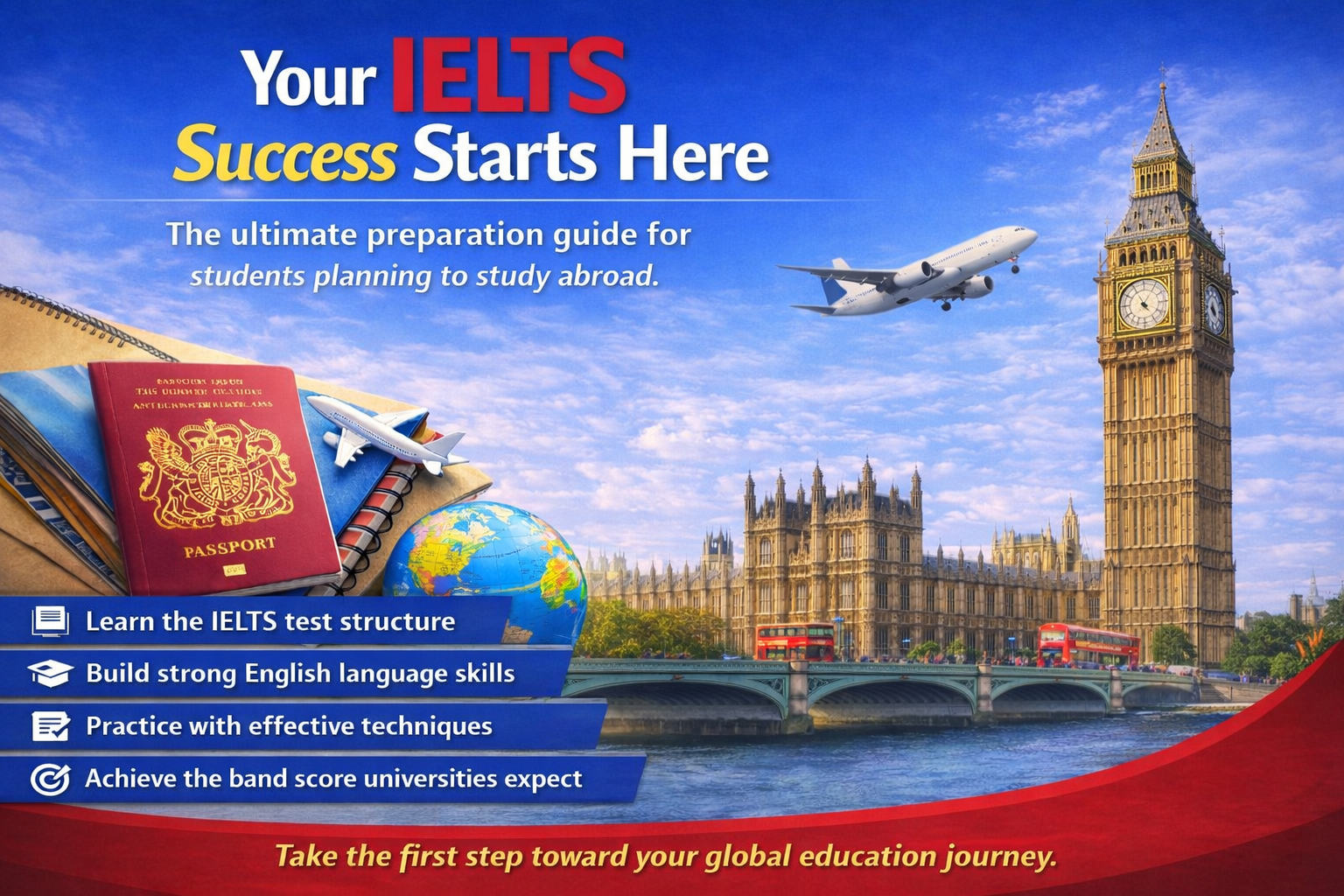
IELTS Preparation Guide for Students Planning to Study Abroad

If you are planning to study abroad, one thing almost every university in the English-speaking world will ask for is proof that you can handle academic English. That proof, for most students, comes in the form of an IELTS score. Getting a good score is not just about ticking a box. It is the difference between a conditional offer and a full acceptance, between a student visa approval and a rejection, and in many cases, between getting the funding you want or missing out.
This IELTS Preparation guide walks you through exactly how to prepare for the IELTS exam, what scores different countries expect, how to tackle each of the four test sections, and what a structured study plan actually looks like. Whether you are just starting or retaking the test, here is everything you need to know.
What Is IELTS and Why Does It Matter for Studying Abroad?
IELTS stands for the International English Language Testing System. It is jointly managed by the British Council, IDP: IELTS Australia, and Cambridge Assessment English. The test measures your ability to read, write, listen, and speak in English at an academic level.
There are two versions. IELTS Academic is what you need if you are applying for a degree program at a university. IELTS General Training is used for work visas and some migration pathways. For students planning to study abroad, IELTS Academic is almost always the right choice.
Scores run on a band scale from 0 to 9. Most top universities in the UK, Canada, Australia, the US, New Zealand, and Ireland require a band score between 6.0 and 7.5 depending on the course level. Postgraduate programs in law, medicine, and education tend to sit at the higher end of that range.
IELTS Score Requirements by Country: A Quick Reference
Before you set your target score, it helps to know what the destination country and your specific course require. Here is a general breakdown based on typical university requirements:
- United Kingdom: Most universities ask for 6.0 to 6.5 overall, with no band below 5.5. Competitive programs at Russell Group universities often require 6.5 to 7.0.
- Canada: Requirements vary from 6.0 to 6.5 for most undergraduate programs. Graduate programs at business schools like the University of Canada or UBC can ask for 7.0 or higher.
- Australia: Generally 6.0 to 6.5 overall. The Australian Department of Home Affairs also uses IELTS scores when assessing student visa applications.
- New Zealand: Most institutions accept 6.0 to 6.5. Immigration New Zealand requires a minimum of 5.5 for a student visa in most cases.
- Ireland: Universities like University College Dublin typically require 6.5. Certain professional courses ask for 7.0 or above.
- USA: American universities tend to use TOEFL more often, but many now accept IELTS. Scores of 6.5 to 7.0 are common requirements for undergraduate and graduate admissions.
Always check the specific requirements of each university and program you are applying to. The scores above are general guidelines, not absolutes.
Breaking Down the Four IELTS Sections
The IELTS Academic test has four parts: Listening, Reading, Writing, and Speaking. Let’s break them down.
Listening (30 minutes + 10 minutes transfer time)
You hear four recordings, each one progressively more complex. The recordings include conversations, monologues, and academic lectures. You answer 40 questions in total. The challenge here is not just understanding what is said but catching specific details, numbers, names, and paraphrased information.
Preparation tip: Train yourself to listen to native English from multiple accents, including British, Australian, American, and Canadian. The BBC World Service, TED Talks, and academic podcasts are all solid resources.
Reading (60 minutes)
You read three long academic texts and answer 40 questions. The texts come from journals, books, and academic publications. Questions test your ability to understand the main argument, identify specific information, recognize the writer’s opinion, and follow logical structure.
Preparation tip: Practice skimming and scanning rather than reading everything word for word. Time management is the most common problem here. Aim to spend no more than 20 minutes per passage.
Writing (60 minutes)
Task 1 asks you to describe a graph, chart, table, or diagram in at least 150 words. Task 2 is an essay of at least 250 words responding to an argument or problem. Task 2 carries twice the weight of Task 1.
Preparation tip: Practice writing structured essays with a clear introduction, two or three body paragraphs, and a conclusion. Work on your grammar range and vocabulary. Avoid repeating the same words and aim for precise, academic language.
Speaking (11 to 14 minutes)
This is a face-to-face interview with an examiner. It has three parts: an introduction and general questions, a long turn where you speak on a topic for two minutes, and a two-way discussion on abstract themes. Examiners assess fluency, coherence, vocabulary, grammar, and pronunciation.
Preparation tip: Record yourself speaking on everyday topics and listen back. Note where you hesitate or struggle for words. Practice with a partner or tutor who can give you honest feedback.
How to Build an Effective IELTS Study Plan
A structured study plan is what separates students who improve consistently from those who plateau. Here is a realistic 12-week plan framework based on your starting level:
- Week 1-2 (Diagnostic phase): Take a full practice test under timed conditions. Identify your weakest band score across the four sections. This tells you where to focus first.
- Week 3-5 (Foundation building): Work on core grammar, academic vocabulary, and listening comprehension. Use official Cambridge IELTS practice books (Books 1-18 are available). Spend at least 90 minutes daily.
- Week 6-9 (Section-specific practice): Dedicate each week to a specific section. Focus on timed practice, not just exposure. Write full essays, time your reading passages, and do speaking sessions with feedback.
- Week 10-11 (Full test simulations): Take at least two complete mock tests under exam conditions. Analyze your errors and revisit specific problem areas.
- Week 12 (Final review): Light review only. No heavy cramming. Focus on staying calm, sleeping well, and knowing the test format inside out.
This plan works best when combined with guided coaching. At Study and Work Abroad, the IELTS coaching program pairs students with experienced trainers who give section-specific feedback, not just generic tips.
Common Mistakes Students Make During IELTS Preparation
Most students who score below their target make one of these avoidable mistakes:
- Studying without a target score in mind: Know the exact score your target universities need before you start. Prepare to exceed it by 0.5 bands as a buffer.
- Ignoring the writing section: Many students over-prepare for listening and reading, then underprepare for writing, which is often the band that pulls the overall score down.
- Not practicing under timed conditions: The IELTS is as much a time management test as a language test. Practicing without a clock does not prepare you for exam day.
- Using non-official materials: Stick to Cambridge IELTS official books, the British Council website, and IDP resources. A lot of third-party material is inaccurate or outdated.
- Booking the test too early: Only register for the test when your mock test scores are consistently meeting or exceeding your target. Rushing wastes money and time.
Computer-Delivered vs Paper-Based IELTS: Which Should You Choose?
Both versions test the same content and use the same scoring system. The main difference is the delivery format and test availability.
Computer-delivered IELTS tends to have more test dates available throughout the month and you get your results in 3 to 5 days rather than 13 days. Typing is faster than handwriting for most people, which can benefit writing scores. The reading and listening experience is also slightly different on a screen versus paper.
Paper-based IELTS suits students who prefer to annotate texts, underline passages, and write notes by hand. If you are not comfortable typing quickly or reading on a screen for extended periods, paper might work better for you.
Both versions are accepted by universities worldwide. Choose the format you are more comfortable with, then practice entirely in that format during your preparation.
How IELTS Fits Into Your Overall Study Abroad Application
Your IELTS score is one piece of a larger application. Universities look at your academic transcript, statement of purpose, letters of recommendation, and in some cases, a portfolio or entrance test score alongside your English proficiency result.
That said, a strong IELTS score can open doors that an average academic profile might otherwise close. Some universities offer conditional admission to students who meet academic requirements but fall slightly short on IELTS, giving them a chance to resit and resubmit.
If you are working with a consultant to plan your study abroad application, make sure your IELTS test date is scheduled at least six to eight weeks before your application deadlines. Study and Work Abroad helps students build timelines that account for test preparation, score reporting, and submission windows so nothing gets missed.
Free and Paid IELTS Preparation Resources Worth Using
Here are genuinely useful resources, categorized by type:
Official and Free
- British Council IELTS website (britishcouncil.org) offers free practice tests, sample answers, and band descriptors.
- IDP IELTS (idp.com) provides free mock tests and score estimators.
- Cambridge English on YouTube offers free listening and speaking sample test walkthroughs.
Paid but Worth It
Cambridge IELTS Official Practice Books (Books 1-18): These contain actual past test papers and are the gold standard for test preparation.
Magoosh IELTS: An affordable online prep platform with video lessons and practice questions. Good for students who prefer self-paced learning.
Coached preparation through a reputable study abroad consultant: This gives you personalized feedback that self-study cannot replicate, especially for writing and speaking.
Next Steps: Getting Your IELTS Preparation Right
The IELTS exam is straightforward once you understand what each section tests and how to prepare for it. The students who score well are almost never the ones who crammed in the final week. They are the ones who built consistent daily habits, practiced under timed conditions, got feedback on their writing and speaking, and went into the test knowing exactly what to expect.
If you are planning to study abroad and need help mapping out your IELTS preparation alongside your university applications and visa timelines, that is exactly the kind of support Study and Work Abroad offers. From IELTS coaching to admission guidance, student visa assistance, and pre-departure support, the team at Study and Work Abroad guides students through every step of the process.
Start with your diagnostic test, know your target score, and build a plan that gives you enough time to get there. That is how you make your study abroad plans a reality.
Frequently Asked Questions About IELTS for Study Abroad
1. What IELTS band score do I need to study abroad?
It depends on the country and course. Most undergraduate programs require an overall band score of 6.0 to 6.5, while postgraduate and competitive programs often ask for 6.5 to 7.5. Always check the exact entry requirements on the university’s official website before setting your target score.
2. How long does it take to prepare for IELTS?
Most students need between 8 and 16 weeks of focused preparation depending on their starting level. If your diagnostic mock test shows you are already at band 5.5 to 6.0, a 10 to 12 week plan is usually enough to push you to 6.5 or 7.0 with consistent daily practice.
3. Can I study abroad without taking IELTS?
Some universities accept TOEFL, PTE Academic, Duolingo, or a Medium of Instruction letter in place of IELTS. A few institutions also waive the requirement if your previous education was entirely in English. Check with each university individually, as policies differ widely by institution and country.
4. How many times can I retake the IELTS exam?
There is no limit on how many times you can take IELTS. You can register for the next available test date after your results are released. Most students who resit the exam after focused preparation on their weak sections see score improvements within one or two attempts.
5. How long is an IELTS score valid for university applications?
IELTS scores are valid for two years from the test date. Most universities and immigration authorities will not accept a score older than two years. If your score expires before your application goes through, you will need to retake the test, so plan your test date carefully relative to your application timeline.