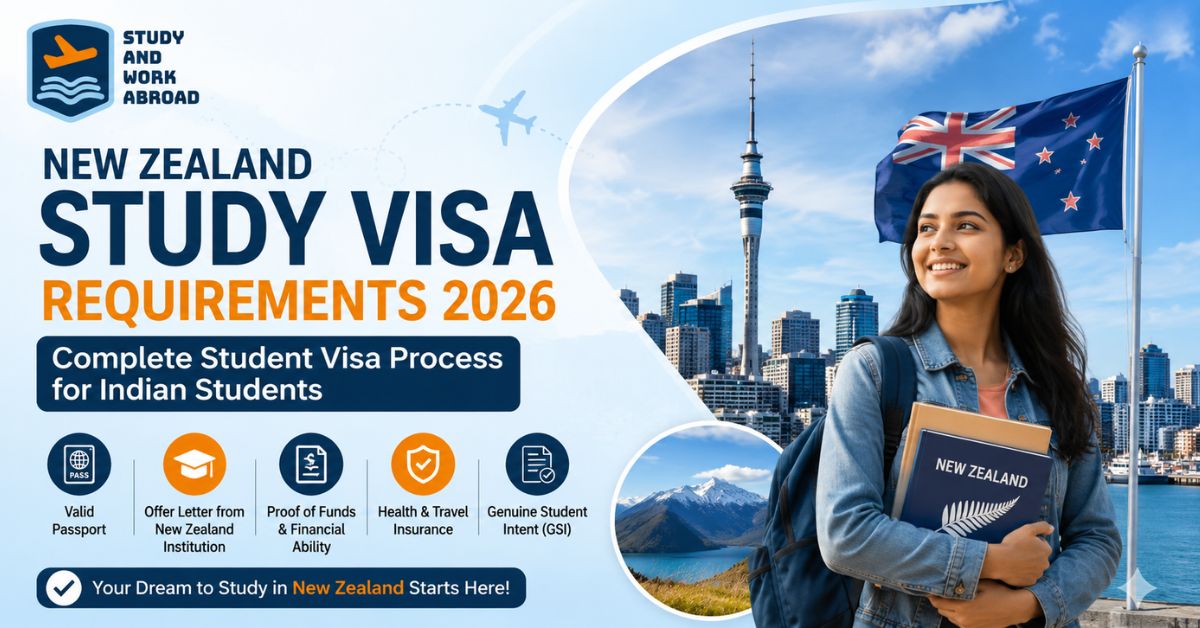
New Zealand keeps climbing the list of top study destinations for Indian students. Strong universities, a genuine post-study work path, and a relatively straightforward visa process all play a part. But the application itself still trips people up, mostly because of paperwork errors, poor financial documentation, or simply not understanding what Immigration New Zealand (INZ) is looking for.
This guide breaks down the New Zealand study visa requirements for 2026, the step-by-step process, the document checklist, costs, and what happens after your degree.
Why Indian Students Choose New Zealand Study Abroad Programs
Before getting into the visa process, here is the short version of why New Zealand has become one of the most popular study abroad program destinations for Indian students:
All eight New Zealand universities rank among the top 3% globally. The country consistently rates as one of the safest in the world. Wellington, Auckland, Christchurch, and Dunedin all offer student-friendly cities with good transport and multicultural communities. And compared to the UK or the US, tuition and living costs are noticeably more manageable.
The post-study work pathway is a strong draw too. After completing an eligible qualification, graduates can stay in New Zealand and work for up to three years. That gives students real time to gain international work experience and build a career before deciding on their next step.
Types of New Zealand Student Visas
Let’s break it down by visa type so you apply for the right one.
Fee-Paying Student Visa — This is the most common visa for Indian students. It lets you study full-time in New Zealand for up to four years. You must be enrolled with an approved education provider and pay your full course fees.
Pathway Student V—This visa covers up to three consecutive courses at approved Pathway education providers on a single visa valid for up to five years. It works well if you plan to move from a foundation program or diploma to a degree.
Student Exchange Visa — For students accepted into an approved student exchange scheme. This allows full-time study for up to four years.
English Language Student Visa — If you are enrolled only in an English language course, this is the appropriate category.
For most Indian students applying for a bachelor’s, master’s, or PhD program at a New Zealand university, the Fee-Paying Student Visa is the right choice.
New Zealand Study Visa Requirements: What You Need
Here is the full picture of what Immigration New Zealand expects when you apply.
1. Offer of Place from an Approved Provider
Your admission must come from a provider registered with or approved by the New Zealand Qualifications Authority (NZQA). Check the INZ website or the NZQA website to confirm your institution is on the approved list. Applying to an unapproved institution will result in an outright visa refusal.
2. Proof of Funds
This is where many Indian students run into problems.
You must show you can cover your tuition fees plus at least NZD 20,000 per year for living costs (equivalent to NZD 1,250 per month). Funds can be in your own bank accounts, your parents’ accounts, fixed deposits, or an approved education loan. Avoid large deposits with no paper trail. INZ wants to see a stable funds history with a clear source for every amount.
The Funds Transfer Scheme (FTS) is the preferred method. This lets you transfer your living expenses to a locked New Zealand bank account before you arrive. The money is released to you in monthly installments to cover rent and food once you are there.
3. English Language Proficiency
You need a recognized test score. The general requirements are:
- Undergraduate programmes: IELTS Academic 6.0 overall, with no band below 5.5
- Postgraduate programmes: IELTS Academic 6.5, with no band below 6.0
- TOEFL iBT: 80 minimum for undergraduate; 90 minimum for postgraduate
- PTE Academic: 50 minimum for undergraduate; 58 minimum for postgraduate
Your score must clearly meet the entry rules for your chosen course.
4. Medical Requirements
If you plan to stay in New Zealand for more than six months, you need a chest X-ray. If you are staying for more than 24 months, a full medical examination by an INZ-approved doctor is required. Book this early since appointment slots fill up, especially in megacities.
5. Police Clearance Certificate
For stays longer than 24 months, you need a police clearance certificate from India and from any other country where you have lived for more than five years. This document confirms good character with no criminal record.
6. Passport
Your passport must be valid for at least three months beyond your intended stay in New Zealand.
7. Statement of Purpose (SOP)
Your SOP explains why you chose this course, this institution, and New Zealand. It needs to show that you have a genuine reason for studying and a clear plan. If your academic background does not directly relate to your chosen course, address that gap directly. A weak or generic SOP is one of the top reasons for visa refusals.
8. Additional Documents
- Certified copies of academic transcripts and certificates
- Proof of tuition fee payment for the first year
- Proof of income or financial support (bank statements, fixed deposit certificates, loan sanction letter)
- Identity proof: PAN card or Aadhaar card. Note that INZ does not accept driver’s licenses, voter IDs, or ration cards as identity proof.
- Accommodation proof or a letter from your institution confirming arrangements
The New Zealand Student Visa Process: Step by Step
Here is the full sequence from application to arrival.
Step 1: Choose Your Course and Institution. Pick a program at an NZQA-approved institution. Confirm the entry requirements match your academic background and English scores.
Step 2: Apply to the institution and get your offer of a place. Submit your university application with transcripts, English scores, SOP, and letters of recommendation where required. Once accepted, you will receive a formal offer of a place letter.
Step 3: Arrange Your Funds. Sort out your financial proof before starting the visa application. This includes arranging your bank statements, fixed deposits, or education loan documents. For the FTS route, plan the fund transfer.
Step 4: Book Your Medical Exam. Schedule your chest X-ray and medical exam with an INZ-approved panel physician. This can take time to arrange, so do not leave it until after you receive your offer.
Step 5: Get Your Police Clearance Certificate. Apply for a clearance certificate from your nearest passport office or through the online portal. Processing can take two to four weeks.
Step 6: Create Your Online INZ Account and Submit Your Application. Since August 2025, all international student visa applications must go through Immigration New Zealand’s upgraded Immigration Online (ADEPT) system. Create an account on the INZ portal, fill in the application form (INZ 1012), upload all documents, and pay the visa fee.
You can submit your application up to 120 days before your course start date. INZ recommends applying at least three months in advance. Most completed applications receive a decision within four to eight weeks.
Step 7: Respond to Any Requests Promptly. If INZ requests additional documents or asks you to attend an interview, respond quickly. Delays in responding extend your processing time.
Step 8: Receive your eVisa. Once approved, you will get an eVisa, a digital document. There is no physical visa sticker in your passport.
New Zealand Study Visa Fees 2026
The visa application fee is NZD 850 for online applications. This fee is non-refundable even if your visa is refused. Additional costs to plan for include:
- Medical examination: approximately NZD 300–500, depending on the clinic
- Police clearance certificate: nominal fee through Indian authorities
- English test fees: IELTS approximately INR 16,500, PTE approximately INR 15,900
- Document translation (if any documents are not in English)
Always check the official INZ website for the most current fee schedule before applying, since fees are subject to revision.
Work Rights on a New Zealand Student Visa
This is one of the strongest features of the NZ study visa requirements framework.
From November 2025, eligible tertiary and secondary students in New Zealand can work up to 25 hours per week during semesters. During scheduled holidays and semester breaks, full-time work is permitted. This change from the earlier 20-hour limit gives students more flexibility to manage living costs while gaining local work experience.
Post-Study Work Visa: What Comes Next
Completing your degree in New Zealand opens the door to the Post-Study Work Visa (PSWV). The PSWV lets graduates stay and work in New Zealand for any employer in any role for up to three years, depending on the qualification level completed.
A new short-term graduate work visa will also open in late 2026. It gives graduates who completed Level 5–7 qualifications (minimum 24 weeks full-time) up to six months of open work rights, useful for students who need time to find employment before moving to an Accredited Employer Work Visa.
One important rule: you can only ever be granted one PSWV. Apply before your student visa expires: within three months for most qualifications and within six months for doctoral graduates.
Common Reasons for Visa Refusals and How to Avoid Them
Indian nationals face a student visa rejection rate of approximately 28%, which sits among the higher rates for NZ student visa applicants. Most refusals come down to a few predictable issues.
- Weak financial documentation: Sudden large deposits without explanation, mismatched bank statements, or insufficient funds
- Poor SOP: Generic reasons for choosing the course or institution, no clear career rationale
- Inconsistent documents: Names, dates, or amounts that do not match across your application
- Non-approved institution: Choosing a provider not listed on the INZ-approved list
- Late application: Applying close to your course start date leaves no room to fix errors
A clean, honest, and complete file submitted well before the deadline gives you the best shot at approval.
How Studying and Working Abroad Can Help
Pulling together the right documents, writing a compelling SOP, and navigating the INZ portal correctly the first time is not always straightforward. Missing one step can delay your application by weeks.
Study and Work Abroad (studyandworkabroad.in) is a Mumbai-based study abroad consultancy that guides Indian students through this entire process, from shortlisting universities and preparing their application to document preparation, visa filing, and pre-departure support. Their team works directly with students on NZ study visa requirements, so nothing falls through the cracks.
If you are planning a 2026 intake in New Zealand and want to make sure your application is structured correctly from the start, reaching out to the team at Study and Work Abroad is a practical next step.
Quick Reference: New Zealand Study Visa Checklist for Indian Students
Use this list before you hit submit:
- Valid passport (minimum six months’ validity beyond intended stay)
- Offer of Place from an NZQA-approved institution
- Bank statements showing NZD 20,000+ per year for living costs, plus tuition
- English language test score (IELTS, TOEFL, or PTE)
- Chest X-ray certificate from an INZ-approved doctor
- Police clearance certificate (for stays over 24 months)
- PAN card or Aadhaar card as identity proof
- Statement of Purpose
- Proof of first-year tuition fee payment
- Academic transcripts and certificates (certified copies)
FAQs
- What are the New Zealand study visa requirements for Indian students in 2026?
Indian students need an offer of a place from an approved institution, proof of at least NZD 20,000 per year in living funds plus tuition, a valid English language score (IELTS 6.0 for undergraduate or 6.5 for postgraduate), a medical certificate, and a police clearance certificate for longer stays. All applications go through the INZ online portal.
- How long does the New Zealand student visa process take for Indian applicants?
Most complete applications take four to eight weeks to process. INZ recommends applying at least three months before your course start date. Applications with incomplete documents, unclear funds, or gaps in history can take longer. Submitting a thorough, well-organized file from the start cuts down on back-and-forth delays.
- Can Indian students work while studying in New Zealand on a student visa?
Yes. From November 2025, eligible tertiary students can work up to 25 hours per week during the semester and full-time during scheduled breaks. This is a recent increase from the earlier 20-hour limit, giving students more earning capacity to manage living expenses and gain local professional experience.
- What is the New Zealand Post-Study Work Visa, and how long does it last?
The Post-Study Work Visa (PSWV) allows graduates to stay in New Zealand and work for any employer after completing an eligible qualification. It lasts up to three years, depending on your qualification level. There is also a new Short-Term Graduate Work Visa from late 2026, offering six months of open work rights for Level 5–7 graduates. You can only be granted one PSWV in your lifetime.
- What is the most common reason Indian students get their NZ study visa refused?
The most frequent causes of refusal are weak or inconsistent financial documentation, a generic statement of purpose that does not clearly justify the course choice, and applying to a non-approved institution. Around 28% of Indian student visa applications are refused. Working with an experienced study abroad consultant like Study and Work Abroad helps ensure your file is complete and correctly structured before submission.